


Now more than ever, digital audio is the foundation of the modern studio - as a result of this, an ergonomic method for interconnecting all of the digital audio equipment within studio spaces is required. As Ray Rayburn states in the Handbook for Sound Engineers:
"In most cases it is preferred to interface digital audio devices in the digital domain, instead of using analog interconnections." (2015: 1439)
While there are a variety of technologies and protocols for interfacing with digital equipment, networked audio looks to be a future staple within the audio engineering community for digital interconnectivity. Networked audio can simply be defined as the transferral of digital audio signals over a network of connected devices, and is not particularly dissimilar from a network of Desktop PCs which, under the right conditions, allow computers in a network to connect and converse with each other. The networked audio solution utilised within this project is Dante, and although there are a number of available networked audio solutions, such as CobraNet, SoundGrid and EtherSound (each with their own merits and drawbacks) this chapter is not directly concerned with appraising each available standard.
1.1 Dante [1]
Understanding Dante and its capabilities as an AoIP [2] solution requires a swathe of knowledge surrounding network engineering. However, network engineering perspectives are outwith the scope of this chapter, and while certain aspects of network engineering knowledge are needed for effective operation of a Dante network, they are not required for the contents or focus of this chapter.
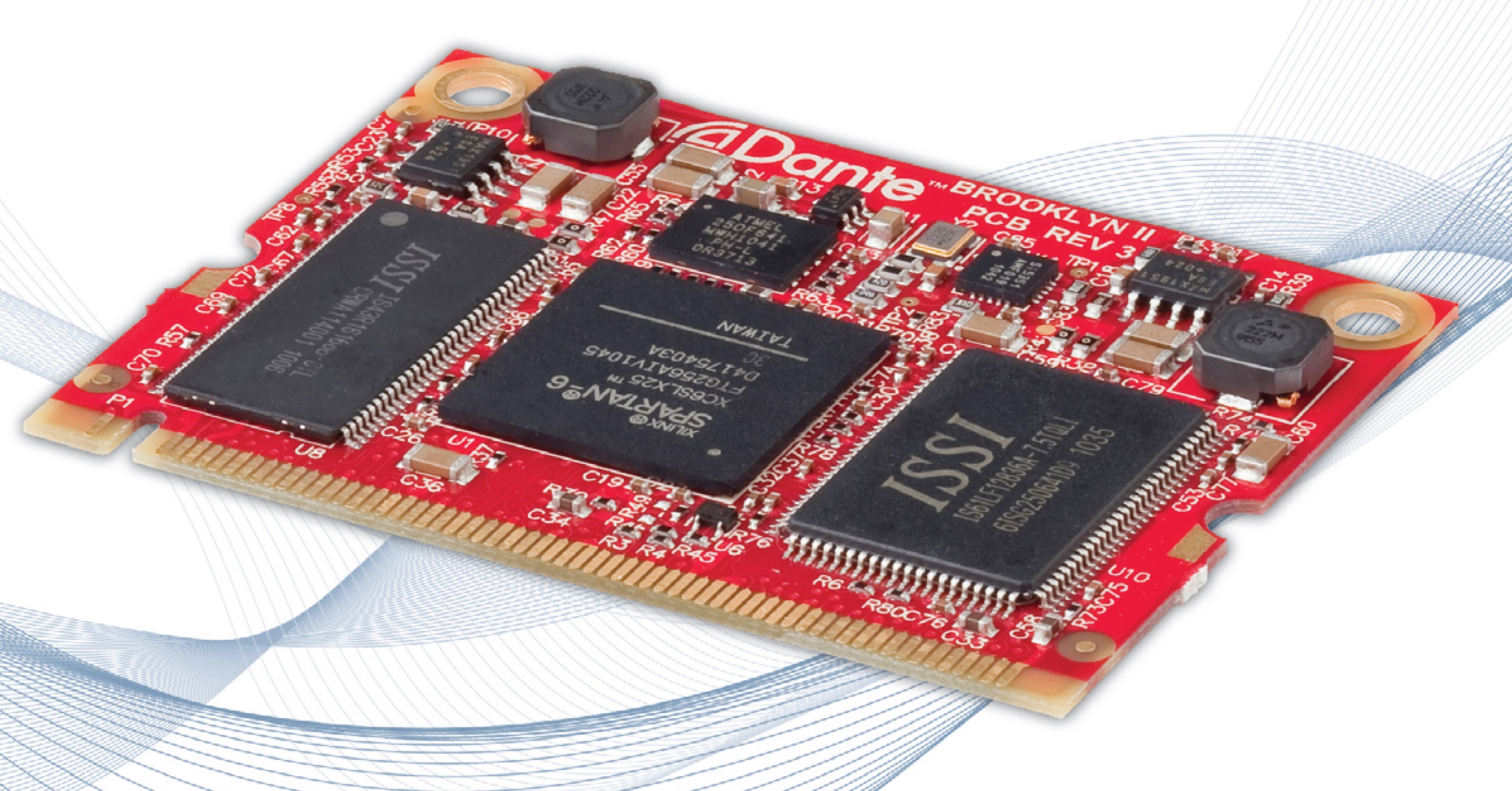
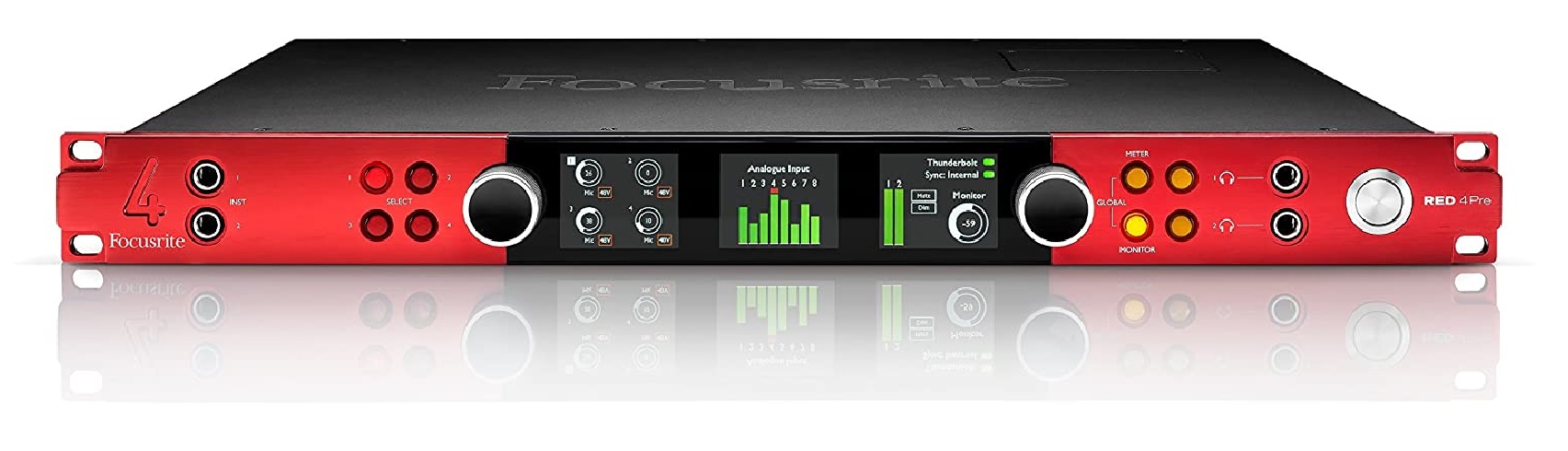
Thus, the easiest path to understanding what Dante is, comes from the knowledge that Dante is primarily implemented via modules (such as the Brooklyn II module shown in Figure 1-1) which are then integrated into other hardware, such as pre-amps, mixing consoles and audio interfaces made by external licensed manufacturers. This means that Dante-enabled devices such as Focusrite's Red 4Pre audio interface (Figure 1-2) are in essence, constituted from two different pieces of equipment.
The 'audio interface' portion of the Red 4Pre, is made and supported by Focusrite, and the 'Dante' portion of the Red 4Pre, is made and supported by Audinate.
This allows for a few distinctions to be made:
- Dante is purely a networked audio solution.
- Audinate is not an 'audio engineering' company in the traditional sense, they are more so an IT company - handling networking.
- Dante-enabled devices are not wholly made by Audinate, purely the Dante module within Dante-enabled devices are made by Audinate.
- A number of Dante-enabled equipment can function in isolation without accessing any Dante specific capabilities, such as the Red 4Pre - which can be used solely as an audio interface.
With these considerations, it is key to point out that any appraisals of equipment within this chapter are more concisely appraisals of Audinate's Dante technology subsumed within each piece of equipment.
1.1.1 Interoperability
As there is no one universal networked audio standard, multiple entities set different technical standards which can result in gated-wall experiences, wherein only a few manufacturers end up supporting each standard. However, Audinate has managed to amass a vast catalogue of licensed manufacturers for Dante - such as Focusrite, Allen & Heath, AKG, Neve and AVID (2021c) - and now acts as an intermediary between the various manufactures.
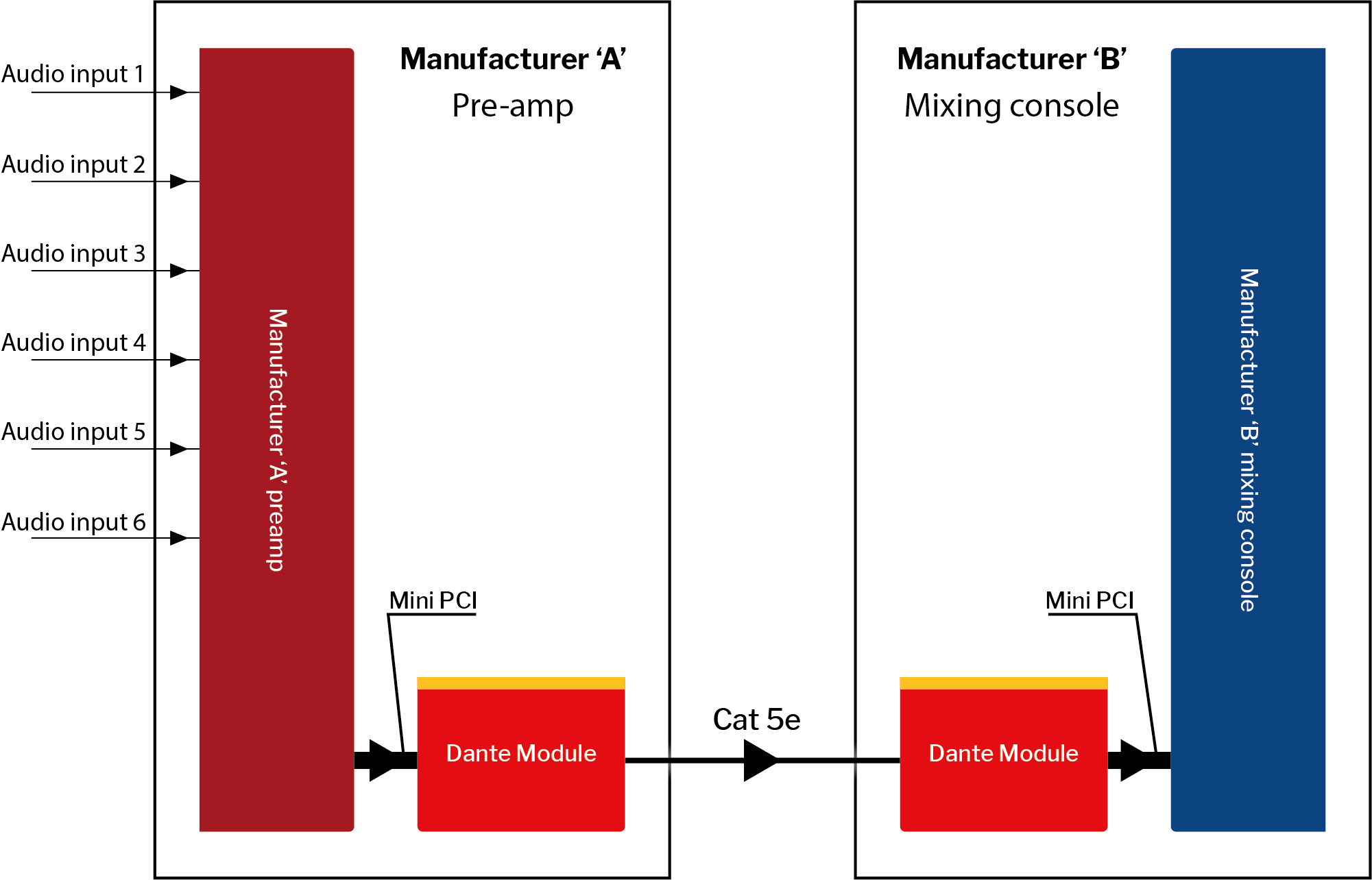
As there are many licensed manufacturers offering Dante-enabled devices, Dante provides interoperability between the various hardware manufacturers. In practice, this means that a Focusrite pre-amp and an Allen & Heath mixer can communicate and exchange audio over a Dante network (per Figure 1-3). This allows for a staggering level of networking functionality and interoperability across a vast amount of licensed-manufacturers, the number of which is certainly larger than alternative networked audio solutions.
1.2 Resource review
1.2.1 Effect of temporal separation on synchronization in rhythmic performance
As networked audio is comprised of digital audio signals which utilise networking equipment, the advantages and disadvantages of networked audio largely contain those of digital audio. As a result of this, networked audio brings with it a major flaw that analogue audio does not meaningfully possess: latency. As such, when planning an event that contains networked audio as an underlying backbone for signal transfer, consideration must be given to ensure acceptable latency at each stage of the session.
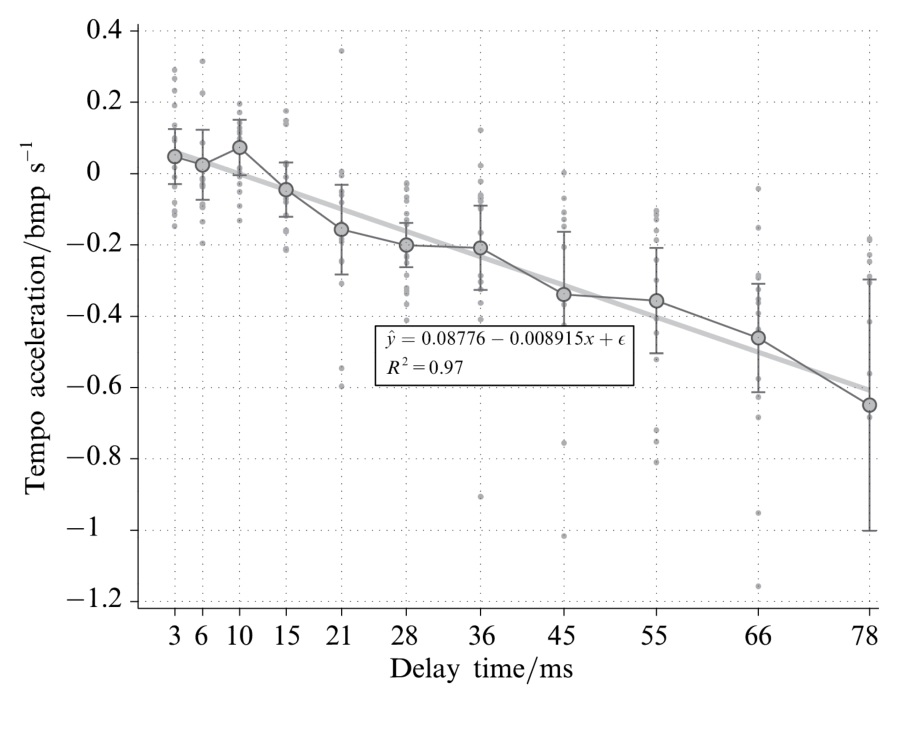
Chris Chafe et al (2010) explore how various lengths of delays affect the ability of individuals to synchronise a musical task. To obtain their findings, two individuals were asked to clap out a rhythm together from two separate sound-isolated rooms via headphones, and without visual contact (p. 982). During the test, a one-way delay was electronically adjusted between the individuals to increase latency anywhere from 3 to 78 milliseconds (msecs).
Their findings have major relevancy when working with digital audio, as it is shown that as latency increases, tempo deceleration occurs (per Figure 1-4) which will degrade the quality of the performance.
This is of particular relevance when considering that as part of this project, during the livestream the band will be performing to pre-recorded content, and so playing to-tempo is critical to ensure the rhythmic integrity of the performance.
1.2.2 Handbook for Sound Engineers
If you were looking for audio engineer's bible, then Glen Ballou's Handbook for Sound Engineers (5th ed) would be it. Effectively all of the fundamental principles upon which audio engineering is based can be found within this handbook. Throughout this book, the reader is provided with as much information as one could need to obtain a rudimentary understanding of audio engineering as a whole.
A wide array of expertise are featured in this book, with different specialists tackling each topic per their specialisations. With regards to this project, there are a few key sections of the book which provide critical explanations for the technologies employed in this project, such as Chapter 29: Consoles, DAWs, and Computers; Chapter 35: DSP Technology and Chapter 42: Digital Audio Interfacing and Networking [3].
Unfortunately, due to the most recent edition (5th) having been published seven years ago, and most likely containing information from well before that, information on Audinate’s Dante is notably lacking. Yet even without an exhaustive appraisal of Dante, sufficient knowledge surrounding audio networking, DSP, and DAWs provide an alternative passage to evaluating networked audio holistically. Even though the book may be seven years old, its contents are still almost entirely relevant to today's audio engineering landscape.
1.3 Networking Infrastructure
As the livestream portion of this project was held at Edinburgh Napier's Merchiston campus, a comprehensive analogue audio and network infrastructure was already in place. Therefore, a combination of networked and analogue infrastructure was naturally exploited. However, if only networking infrastructure was available, with the correct equipment a Dante network could have replaced the need for any analogue audio infrastructure.
As demonstrated by Paul Ferguson and Dave Hook in their article 'Ground Control and Cloud Booths' (2021), Dante is holistically advanced enough to synchronously transmit and receive audio signals from Edinburgh to London via Jisc’s Janet National Research and Education Network (p. 99) [4]. Thus, the validity of Dante's ability to replace audio infrastructure is largely unquestioned, knowing that the upper limit of Dante's capabilities is currently to transverse large geographic distances.
However, I would posit that a 'critical mass' must be reached before a networked audio solution such as Dante should be considered for application. If a recording only requires two microphones, then naturally a solution as sophisticated as Dante is unwise to employ, especially for on-location recordings. However, for the livestream portion of my artefact, the complexity that will be explored in Chapter 4 warrants such a solution. While Dante is indeed flexible, it is - without doubt - a specialised tool to be used in situations which require its unique merits.
1.4 Sharing routes beyond the jackfield
In the world of analogue audio, if you want to route a signal from one piece of equipment to another, a patch bay may more than likely be involved - such as the one in Figure 1-5.
Patch bays are the foundation of professional analogue audio routing, providing a centralised location to connect various physical signal paths, often to and from various pieces of equipment. Yet, in the world of networked audio through the form of Dante, patch bays are no more, and their digital equivalents are now represented in often complex GUIs, such as Dante Controller [5]. In reference to Figure 0-1 on page 5 - to route signals from rooms A1 through A4 to both Studio 1 and Studio A, a complex analogue routing solve would have to be created. Signals would go into Studio 1, and then immediately have to be patched in bulk, with a unique path per signal, all the way into Studio A.
Figure 1-6 shows a broadstroke diagram of an analogue routing path that would be required to achieve the desired outcome without a Dante network. All audio signals would have to be sent to Studio 1 for recording to disk (blue lines), and then immediately patched through to Studio A for mixing/mastering (via red lines). In this particular circumstance, 72 patch cables would be required on the red run alone to patch through the 24 signals to Studio A [6]. Not only would this require a sufficient analogue audio routing infrastructure to be present, but this is a significant ask for the capabilities of most audio departments.
Whereas, Figure 1-7 illustrates that with the application of networked audio, Studio A can access all audio which has been routed into Studio 1 purely through the Dante network - provided that Studio 1 and Studio A have Dante-enabled devices connected to the same network (illustrated by dark blue line).
Additionally, Dante provides bidirectionality, allowing devices to both sent and receive audio simultaneously, as opposed to the unidirectionality of analogue audio signals which only allow for audio to be sent in one direction: i.e. either from A to B or B to A.
It is also worth noting that the complexity of routing signals in general does not decrease just because it can be facilitated via a GUI, as the complexity of Dante's routing capabilities can be just as perplexing unless an equally comprehensive routing solve has been created [7] (see Appendix 1 - Dante routing solve for routing used for livestream).
1.5 Dante network setup
The ability of audio networking to transport large amounts of audio channels without any significant cabling requirements was a major reason for its inclusion. Without the ease of transport for large channel counts, many of the ambitions regarding the live audio production of the livestream would have been impractical to achieve.
In order to create the most efficient Dante network, a balance had to be struck - as not enough Dante-enabled equipment was available to connect each computer within the network to its own Dante-enabled hardware. However, even with a limited number of Dante-enabled equipment, Audinate offer an alternative software solution to connecting computers to a Dante network: Dante Virtual Soundcard (DVS).
DVS enables a computer to access a Dante network by connecting the Ethernet port of any computer, to a Dante network - in the same manner as Dante-enabled hardware. While DVS is a particularly able offering: providing up to 64 channels of simultaneous input and output with any connected Dante network, the minimum latency is unfortunately 4msecs, which is significantly more than is practical for working with live audio.
1.5.1 Initial plan
During the process of calculating the most efficient arrangement of Dante-enabled equipment, many iterations of possible Dante setups were explored. In Figure 1-8 an initial schematic for the Dante network is shown.
This initial plan allowed for all signal routing between control rooms to be facilitated via the Dante network, but when the signal chain was tested - it resulted in unacceptable latency values. As Table 1-1 shows, an output latency of 16.8msecs was present.
As Studio 1 handled both the audio inputs and headphone foldbacks, the band were able to monitor themselves via headphones without any digitally incurred latency via the Dante network. However, in this scenario the audio would be paired with the video output of the livestream at just under 17msecs late. While the ATSC's (Advanced Television Systems Committee) recommendation for sound & video synchronisation is between +15msecs and -45msecs (ATSC 2003), in a live mixing scenario, less latency is better. Thus, although the audio output latency was within the ATSC guidelines, a reduction was possible, and so further work was conducted.
1.5.2 Final plan
After battling with latency times, and deliberating over equipment assignments, a number of changes were made per Figure 1-9:
Within the SSL Booth it was decided that analogue inputs were more feasible than incurring 4msecs of latency via DVS - as the SSL Booth was receiving Studio 1's MIDI Beat Clock, which was synchronising the playback of the two devices. This meant that unnecessary latency would impact the integrity of the playback synchronisation.
Sending the mastered stereo output of the mix to the PC/OBS machine via DVS was simply unnecessary. A simple S/PDIF connection seemed the most suitable method, as this provided identical functionality, without any meaningful latency.
The above changes resulted in a new output latency of 8.8msecs, per Table 1-2.
1.6 Conclusion
In terms of infrastructure, where one once required high counts of long distance cable runs, a single networking port in a room is now enough to enable abounding connectivity. Transmitting large amounts of audio between distant rooms no longer requires a massive cabling and patching feat.
However, although only mentioned briefly, it truly is critical that audio engineers working with networked audio possess a working understanding of relevant network engineering concepts. Buzzwords such as 'network topology', 'DHCP', 'subdomains' and 'IPv4' - while largely irrelevant to this chapter, are slowly transitioning into the common audio engineer's vocabulary behind the scenes.
As Ferguson and Hook write, regarding networking and the technical requirements of connectivity on audio engineers:
"In reality, this is becoming part of the engineer’s toolkit... and therefore will become as invisible to the musician as patching or syncing equipment within the ground control space." (2021: 103)
While Dante has the capacity to work immediately out of the box, it inevitably places another layer of complexity upon the shoulders of already burdened audio engineers, which has the potential cause further issues. As an audio engineer, being able to diagnose and remedy any audio issues that present themselves is an essential part of the job, and now the requirement to interact with and address issues which reside in realms previously inhabited only by network engineers may become a de facto standard.
Ultimately, my own path with network engineering will be to continue to work with Dante; the next stage may be to quantity its utility in on-location recording sessions, as the next project I am planning involves a large venue MILR. However, to those looking to use Dante - mindfulness should be applied when considering if networked audio is really the do-all solution for your studio needs. Although Dante was the backbone of the live audio for this project, there were still plenty of analogue audio connections, without which, this project would have been far too reliant on 'high-tech' solutions to very simple predicaments.
[1] Dante (not capitalised) is an acronym, standing for Digital Audio Networked Through Ethernet (2021d).
[2] AoIP means Audio-over-Internet-Protocol
[3] DSP = Digital Signal Processer (also Digital Signal Processing). DAW = Digital Audio Workstation.
[4] 'Synchronously' denotes that the devices transmitting and receiving the signal are both locked to the same master sampling rate clock. See page 439 in Ballou's Handbook for Sound Engineers (5th ed) for further reading.
[6] The reason the number is 72 patch cables, is that there are 3 patch bays to cross in this particular scenario from Studio 1 to Studio A; 24 * 3 = 72.
[7] Solve, as a noun = a solution to a complex puzzle.


.png)


